
Have any questions?
+91 83 6090 9060
info@cxojunction.com
Have any questions?
+91 83 6090 9060
info@cxojunction.com
In today’s fast-evolving digital landscape, the role of IT leadership is undergoing a fundamental shift. No longer confined to managing systems and responding to disruptions, IT leaders are now expected to drive foresight, resilience, and strategic alignment across the business.
In this edition of #CEOAspect, Nilesh Mehta, Founder & CEO of NGenious Solutions, shares his perspective on why modern IT leadership must move beyond reactive problem-solving and embrace a more proactive, future-ready approach.
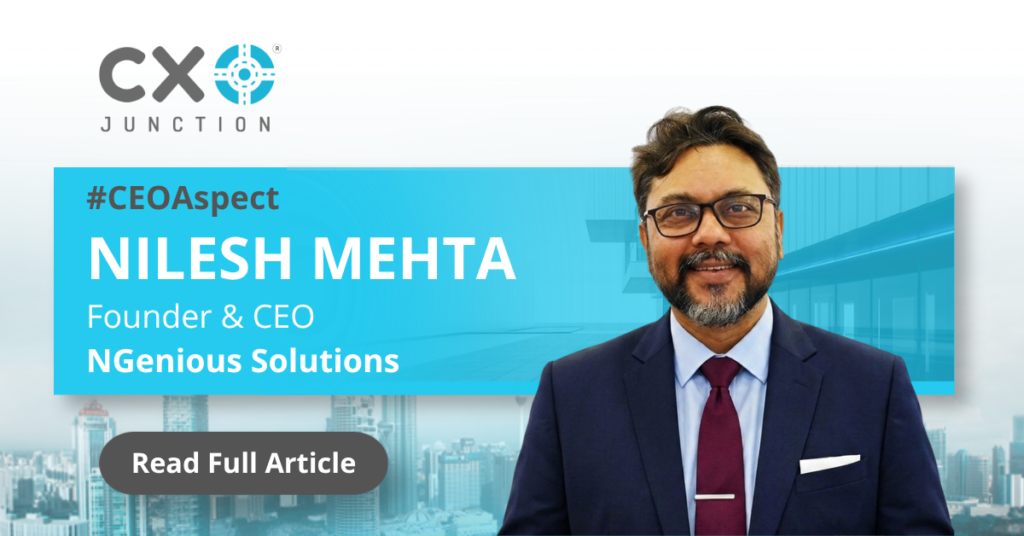
Sharing his thoughts on “From Reaction to Readiness: Redefining Modern IT Leadership,” he says:
There was a time when strong IT leadership was mostly about response. A system went down, a process broke, a user escalated an issue, and the IT team stepped in to resolve it. Speed mattered. Control mattered. Stability mattered.
That remains important. Yet, in today’s environment, IT leadership must go further.
If IT is only reacting, it is already too late.
Technology now sits much closer to the heart of the business than it did a few years ago. It shapes operations, customer experience, risk, compliance, collaboration, and the speed at which decisions are made. In that environment, IT cannot just be the team that steps in when something goes wrong. It has to help the business identify issues earlier, prepare better, and make smarter decisions before problems grow.
And yet, many organisations are still operating in reactive mode.
I have seen companies invest in cloud, automation, analytics, and now AI, while continuing to work in the same old way. Teams wait for something to fail before acting. Priorities shift only when the pressure becomes visible. Leaders assume progress is happening because there is movement, but movement is not the same as control.
That is where many transformation efforts quietly fall apart.
In my experience, transformation usually does not fail because the intent was wrong. It fails because execution remains fragmented. The technology roadmap moves in one direction, business expectations move in another, and somewhere in between, momentum gets lost. New systems are introduced, but old habits remain. Dashboards are added, but decisions do not improve. Automation gets layered onto broken processes, and the organisation ends up carrying the same inefficiencies into a more modern environment.
This is why modern IT leadership must fundamentally shift from reactive to proactive.
The shift starts with a different question: not “How do we respond faster?” but “Why are we still getting surprised by issues we should have seen coming?” That question changes the role of leadership. It forces a closer look at process design, data quality, governance, ownership, user adoption, and technical debt. It pushes the conversation away from firefighting and towards prevention.
That is where real maturity begins.
This becomes even more important in an AI-focused environment. Right now, almost every enterprise wants to talk about AI. That makes sense. The opportunity is significant. But AI is not a fix for weak fundamentals. It does not clean up poor data. It does not solve broken workflows. It does not create accountability where none exists. If the basics are not in place, AI will only expose those gaps faster.
That is why the strongest IT leaders I know pay close attention to the foundations: clean data, clear ownership, connected systems, reliable processes, and better visibility. These are not background issues. They are the difference between technology that creates value and technology that creates more noise.
There is also a leadership mindset that needs to change. In many organisations, heroics are still rewarded too heavily. A crisis happens; someone jumps in, works late, saves the day, and gets recognised. But that is not a mature operating model. It may look impressive in the moment, but it is not sustainable. Strong organisations are not built on heroics. They are built on consistency. They reduce avoidable friction. They document well. They standardise well. They create systems and processes that people can trust without constant intervention.
That, to me, is what proactive and modern IT leadership really means.
The IT leaders who will stand out in the coming years will not be the ones talking the most about transformation. They will be the ones helping the business stay ahead of problems, make better decisions, and move with fewer surprises.
That is what modern IT leadership really demands.
The takeaway is unmistakable: the shift from reaction to readiness is no longer optional, it’s essential.
CXO Junction remains dedicated to providing you with exclusive insights into transformative leadership journeys. Stay tuned for more updates as we continue to bring industry news to you.